Korea's coffee capital
isn't Seoul
The case is one sentence long: in 2019, Jeon Joo-yeon of Busan's Momos Coffee won the World Barista Championship — the first Korean champion ever, and she came out of a Busan roastery, not a Seoul one. Drink accordingly: Jeonpo Café Street for density, Momos's harbourside Roastery & Coffee Bar on Yeongdo for the flagship experience, Dalmaji Hill for sea views. A cappuccino runs about ₩5,000 (~$3.50) almost everywhere.
One champion, one street, one harbour
The caseThe champion. Momos Coffee started as a neighbourhood shop by Oncheonjang and grew into the roastery that trained Jeon Joo-yeon to the 2019 World Barista Championship title. The original Oncheonjang flagship (Line 1 · Oncheonjang Station) is the pilgrimage; the Roastery & Coffee Bar on Yeongdo is the showpiece — order a single-origin filter and let them choose the beans.
The street. Jeonpo Café Street (전포 카페거리) is what happened when a hardware district's workshops emptied and roasters moved in — dozens of cafés packed into a few blocks between Seomyeon and Jeonpo Station (Line 2). Choosing badly here costs you 40 metres, not a morning.
The names. On any Busan menu board, two locals to trust: Blackup, the homegrown chain that out-coffees the global ones, and WERK, a Busan roaster the third-wave crowd treats as a password. Both beat defaulting to the green mermaid — though Busan does hold the world's highest Starbucks, on the 99th floor of X the Sky, if you want coffee as a viewpoint decision instead.
Where to caffeinate, by mood
The mapBusan is a 40 km ribbon; pick the café scene that's already on your route.
| Area | The scene | Getting there |
|---|---|---|
| Jeonpo Café Street | Maximum density — roasters, dessert labs, stationery-shop hybrids | Line 2 · Jeonpo Station (전포역), then wander — it starts within 5 minutes' walk |
| Yeongdo | Momos Roastery & Coffee Bar and harbour-view warehouse cafés | Bus over the bridge from Nampo Station (Line 1) — pair with Huinnyeoul |
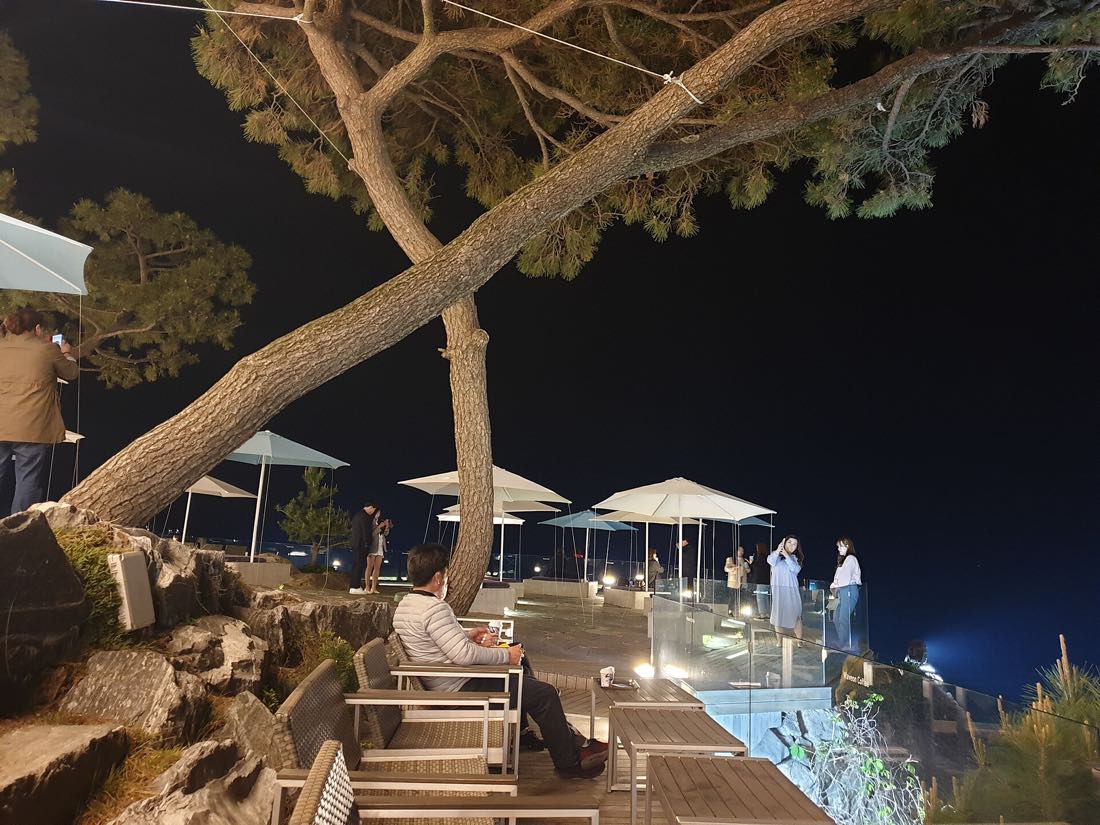
| Dalmaji Hill | The sea-view strip above Haeundae — cherry trees in late March | From Haeundae: 10–15 min by bus or taxi up Dalmaji-gil |
| Oncheonjang | The Momos original — worth it for beans and the origin story | Line 1 · Oncheonjang Station (온천장역) |
| Gwangalli | Bridge-view cafés along the beach road | Line 2 · Gwangan Station (광안역), Exit 3 or 5 |
Rainy jangma day? Cafés are the official sport — the full wet-weather plan is at rainy-day Busan.
How Busan café culture actually works
Culture notesMornings are a trap. Most independent cafés open around 10:00 and hit stride mid-afternoon; coffee before 09:00 is a convenience-store errand. Plan café stops as afternoon anchors, not breakfast.
Laptops are welcome. Korean cafés are working spaces by default — order roughly one drink per 2 hours and nobody blinks. It's why Busan's café stock doubles as office stock for the digital-nomad crowd.
Prices are flat. About ₩5,000 (~$3.50) buys a cappuccino at a world-class roaster or a mediocre franchise — the quality spread is huge and the price spread isn't, which is the whole argument for choosing well. Cards work fine in cafés, unlike the market food next door.
The practical bit
Plan the stopCoffee, attached to a plan
Build it inNobody needs a tour to drink coffee — attach the café streets to a day instead.
Busan coffee questions, answered
FAQPage schema pairedWhy is Busan called Korea's coffee capital?
Because the receipts are local: Momos Coffee's Jeon Joo-yeon won the 2019 World Barista Championship — the first Korean ever to take it — roasting and training in Busan, and the city backs it with the Jeonpo café district and a serious independent-roaster scene.
How much does coffee cost in Busan?
About ₩5,000 (~$3.50) for a cappuccino, whether the roaster is world-class or forgettable. Convenience-store cans and drips run under ₩2,000 if you just need the caffeine.
Where is Jeonpo Café Street?
Between Seomyeon and Jeonpo Station on Line 2 — from Jeonpo Station you're in it within a 5-minute walk. It's a grid of converted workshops rather than one street, so wander; the density does the curating for you.
What is Momos Coffee?
Busan's flagship roastery: founded by Oncheonjang Station (Line 1), home of the 2019 World Barista Champion, with a harbourside Roastery & Coffee Bar on Yeongdo. Order the single-origin filter — the beans are the point.
Are Busan cafés laptop-friendly?
Very — working from cafés is normal across Korea. Most open around 10:00, run to 21:00 or later, and the informal rule is one order per 2 hours. Long-stay practicalities live at the digital-nomad guide.
Which Busan café area has the best views?
Dalmaji Hill, the strip above Haeundae — sea views, and in late March (around 25 Mar–1 Apr) the cherry trees turn it into one of Busan's best blossom spots without leaving town.
Can I pay with a foreign card at Busan cafés?
Almost always — cafés sit firmly on the card-friendly side of Korea's split economy, so the ~₩5,000 (~$3.50) cappuccino is a safe tap. The cash problem lives elsewhere: markets, street stalls and small restaurants. Keep ₩50,000-odd (~$35) in cash for those and let the card handle the coffee.
Where should I go for coffee on a rainy day in Busan?
Jeonpo — the café grid 5 minutes' walk from Jeonpo Station (Line 2) is dense enough to hop between roasters without ever being more than a minute from a dry doorway. During jangma (late June–late July, when July alone averages 327 mm of rain) it's the best wet-weather neighbourhood in the city; the full plan is at rainy-day Busan.
Continue planning
Keep decidingEat it with a local
Busan food tours & tastings — guided street-food crawls and cooking classes with vetted operators, most with free cancellation.