What to eat in Busan
and what it should cost
Busan's canon is short and cheap: dwaeji gukbap (돼지국밥) at ₩5,500–9,000 (~$4–6), cold milmyeon noodles at ₩7,000–9,000 (~$5–6), and raw fish at Jagalchi or Millak for ₩30,000–50,000 per person (~$21–35) all-in — including the ₩5,000pp table charge (상차림비) that surprises foreigners. Bring cash: the best of it lives in markets where foreign cards fail. Tipping doesn't exist and banchan refills are free.
A cuisine invented by refugees
The storyBusan's two signature dishes are war documents. From 1950 to 1953 this was South Korea's provisional wartime capital, and the influx of refugees roughly doubled the city almost overnight. People cooked with what a port city at war could supply: pork bones cast off from US military bases went into the milky broth that became dwaeji gukbap, and American aid wheat replaced the buckwheat that northern refugees could no longer get, turning their beloved naengmyeon into milmyeon. This isn't marketing gloss — the Provisional Capital Memorial Hall documents the period, and the Michelin Guide's own Busan editorial tells the same story.
It's why eating cheap here isn't slumming — it's the point. The 2026 Michelin list made it official: the stars went to Haeundae fine dining, but the value badge went to pork soup.
Every Busan dish, priced
The canonEvery price on this page was checked on 6 August 2026 against official or primary sources. Korean attraction prices move fast and sources disagree; where we couldn't verify a number, we say so instead of guessing.
| Dish | What it is | Price | Where |
|---|---|---|---|
| Dwaeji gukbap 돼지국밥 | Milky pork-bone soup with rice — the city's signature | ₩5,500–9,000 (~$4–6) · premium ₩10,000–13,000 (~$7–9) | Everywhere — start with the full guide |
| Milmyeon 밀면 | Cold wheat noodles, Busan's own answer to naengmyeon | ₩7,000–9,000 (~$5–6) | Same shops, summer queues |
| Hoe 회 (raw fish) | Korean-style raw fish with the full spread of sides | ₩30,000–50,000pp (~$21–35) all-in, incl. the ₩5,000pp table charge | Jagalchi or Millak Raw Fish Town |
| Dongnae pajeon 동래파전 | Seafood-heavy green-onion pancake, shared | ₩20,000–40,000 (~$14–28) | Dongnae's originals, north of the centre |
| Kkomjangeo 꼼장어 | Hagfish on charcoal — the late-night dare that converts people | From ₩60,000 (~$42) a portion | Jagalchi's grill alleys |
| Korean BBQ | Pork belly up to hanu beef (₩150,000–400,000+ territory) | ~₩22,000pp (~$15) · AYCE pork ₩15,000–35,000 | Seomyeon back streets |
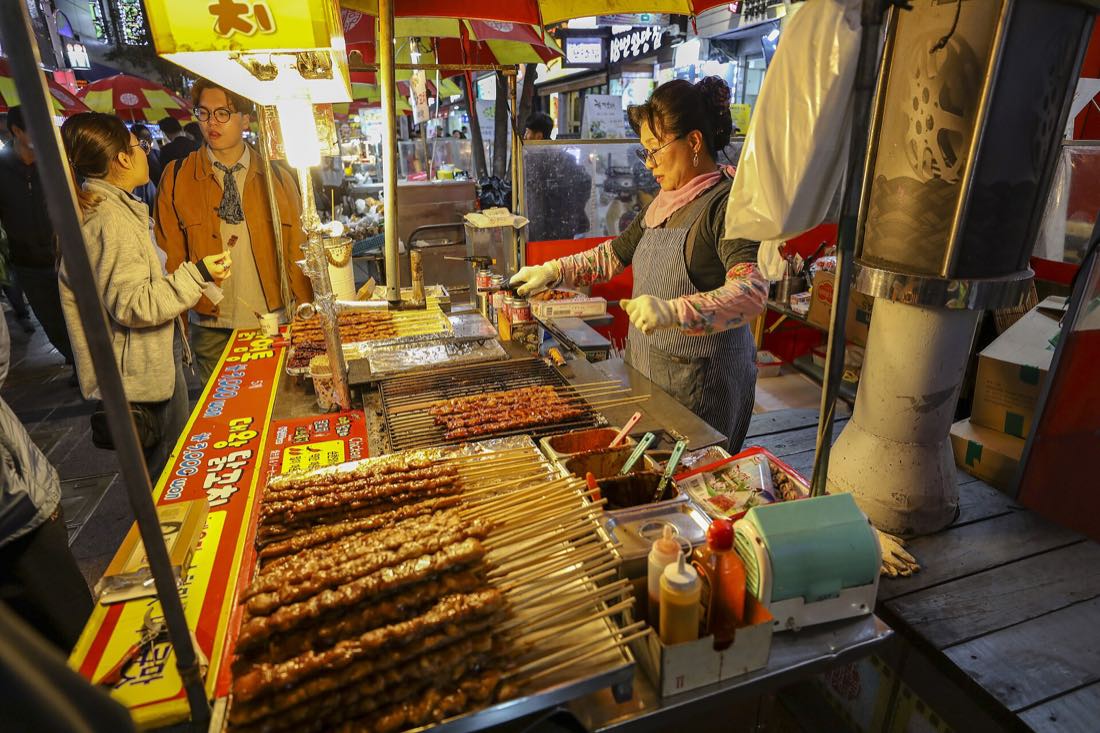
| Ssiat hotteok 씨앗호떡 | Seed-stuffed fried pancake — a BIFF Square invention | ₩1,000–4,000 (~$0.70–2.80) | BIFF Square, Nampo |
| Street food generally | Eomuk, tteokbokki, the market circuit | ₩1,000–4,000 a piece | Gukje and Bupyeong markets |
| Soju | The table's lubricant | ₩1,500–2,000 (~$1–1.40) convenience store · ₩4,000–6,000 restaurant | Anywhere with green bottles |
| Coffee | A cappuccino in a serious roastery town | ~₩5,000 (~$3.50) | Jeonpo Café Street |
Dinner for two at a normal restaurant lands around ₩65,000 (~$45). The ajumma will refill your banchan before you ask — the only tip she wants is an empty bowl.
Where to eat what, by neighbourhood
The mapBusan is a 40 km ribbon, so pick the dish that lives where you already are — crossing the city for dinner costs an hour each way.
| Neighbourhood | Eat this here | Why |
|---|---|---|
| Nampo + Jagalchi | Hoe, kkomjangeo, ssiat hotteok, market snacks | The market core — cash country, and the reason food tours start here |
| Seomyeon + Jeonpo | BBQ, the gukbap alley, third-wave coffee | The density play: most restaurants per metre in the city |
| Gwangalli + Millak | Raw fish upstairs with the bridge view | Millak Raw Fish Town is Jagalchi's sit-down cousin |
| Haeundae + Dalmaji | The Michelin cluster | All four 2026 stars orbit this end of the ribbon |
| Yeongdo | ARP (the vegan Bib Gourmand), Samjin's original eomuk factory | Least-covered in English, best casual eating per won |
Cash, vegetarians, halal — the reality
The honest bitsCash. Korea is card-first until the moment you're hungry. Foreign cards work at convenience stores, chains, hotels and taxis, and routinely fail at traditional markets and street stalls — exactly where Busan's food is. Carry ₩50,000–100,000 in cash for a sightseeing day, double that for a serious market crawl. Tap-to-pay barely exists; don't plan around it. The dedicated page: money in Busan.
Vegetarians. Harder than it should be — fish stock and shrimp paste hide in almost everything, including 'vegetable' dishes. The honest fix is aiming at places that declare themselves: ARP on Yeongdo is a fully vegan Bib Gourmand with mains around ₩10,000 (~$7), and temple-food and salad-bowl spots cluster near Seomyeon. Expect to explain yourself elsewhere.
Halal. Thin but real: Busan Al-Noor is KMF-certified with mains around ₩10,000–18,000 (~$7–13), and convenience stores make the gaps survivable. Plan proteins ahead rather than improvising at markets.
Tipping. None. Not at restaurants, not for delivery, not in taxis. Attempting it causes confusion, not gratitude.
What a day of eating costs
Budget mathsThe food, booked
Eat with backupYou don't need a tour to eat well here — but the market tours solve ordering, portions and the cash dance in one go, and the first market morning teaches you how to do the rest of the trip alone.
Busan food questions, answered
FAQPage schema pairedWhat food is Busan famous for?
Dwaeji gukbap (pork-rice soup, ₩5,500–9,000), milmyeon (cold wheat noodles, ₩7,000–9,000), raw fish at Jagalchi, Dongnae pajeon, and ssiat hotteok — a seed-stuffed pancake invented at BIFF Square that costs ₩1,000–4,000. The first two were born in the Korean War, which is the real story of Busan eating.
Is food cheaper in Busan than Seoul?
Eating out, clearly yes — Seoul restaurants run about 23.8% more expensive. The counter-intuitive part: groceries actually cost about 7.4% more in Busan, so the win is specifically restaurants and street food, not supermarkets.
Do you tip in Busan?
No — tipping is a flat 0 in Korea: restaurants, taxis, delivery, everywhere. Banchan (side dish) refills are free too; asking for more is normal, not cheeky.
What is the table charge at fish restaurants?
A 상차림비 (sangcharimbi) of about ₩5,000 (~$3.50) per person, charged wherever you bring fish to be prepared or order raw fish with the full spread of sides. It covers the banchan, lettuce, sauces and setting — it's standard practice, not a tourist surcharge, but it surprises people who didn't see it coming.
Can vegetarians eat well in Busan?
With planning. Fish stock hides in most soups and sauces, so aim at declared options: ARP on Yeongdo is a fully vegan Bib Gourmand with mains around ₩10,000, and convenience stores label ingredients clearly. Random-restaurant roulette works poorly here.
How much should I budget for food per day in Busan?
₩25,000–40,000 (~$17–28) eats genuinely well on the cheap end — gukbap, street food, a convenience-store dinner. ₩60,000–100,000 (~$42–70) is comfortable with a proper raw-fish dinner in it. Carry most of it as cash for the markets.
Is Jagalchi Market worth it for food?
Yes, with a plan: pick your own fish downstairs, agree the price first, eat it upstairs, and expect the ₩5,000pp table charge on top. Going to browse rather than to eat is how it earns its 3.9 TripAdvisor rating — the full strategy is at Jagalchi, honestly.
Continue planning
Keep decidingEat it with a local
Busan food tours & tastings — guided street-food crawls and cooking classes with vetted operators, most with free cancellation.