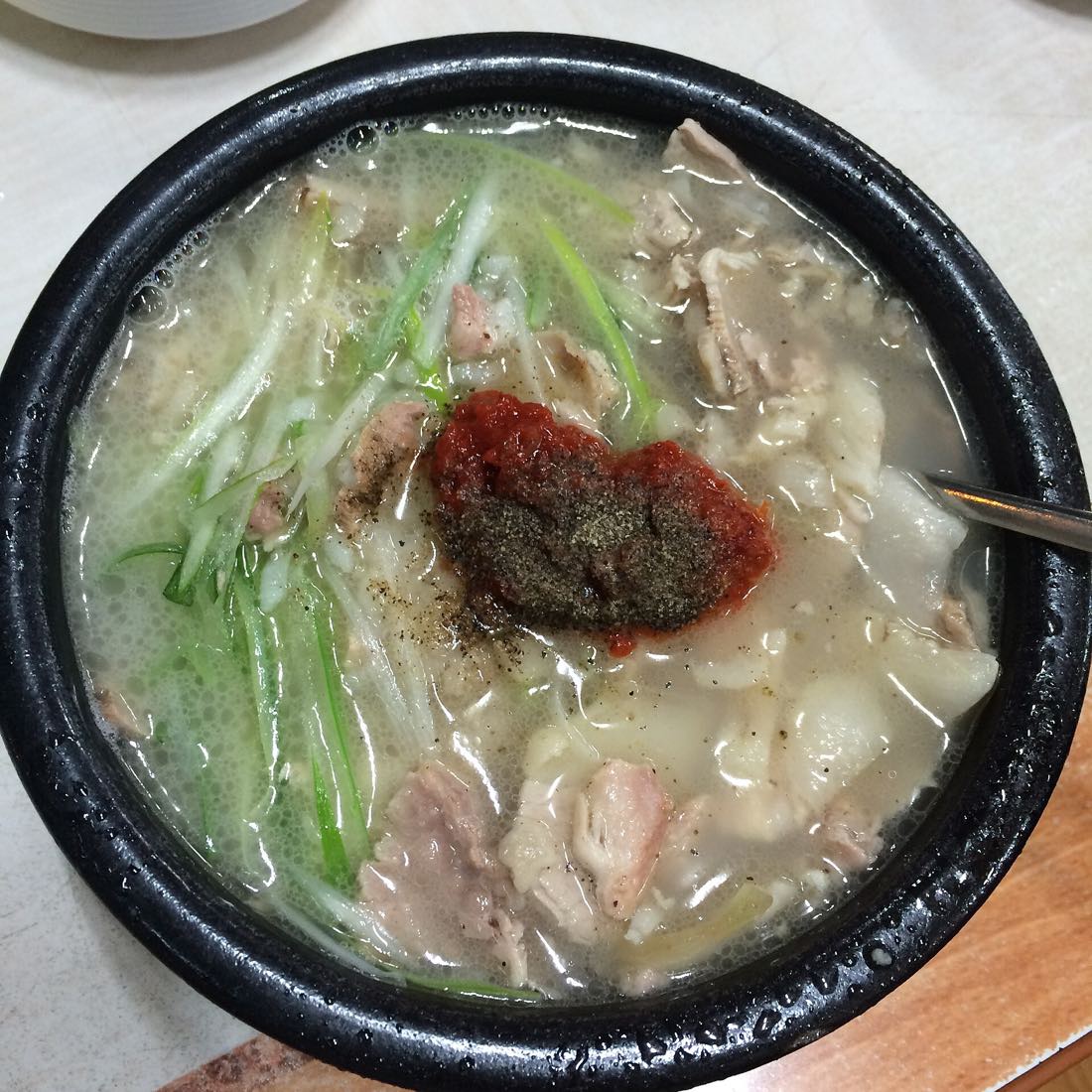
Dwaeji gukbap:
Busan in a bowl
Dwaeji gukbap (돼지국밥) is milky pork-bone soup served over-the-fire hot with rice, ₩5,500–9,000 (~$4–6) for a bowl that counts as a full meal — premium versions top out around ₩10,000–13,000 (~$7–9). It arrives deliberately under-seasoned: you finish it at the table with salted shrimp, chives and chili paste, and that ritual is half the dish. The 2026 Michelin Bib Gourmand list is dominated by it — three named bowls below.
What the war put in the pot
The historyBetween 1950 and 1953 Busan was South Korea's provisional capital, and war refugees roughly doubled the city. Flat land, housing and food were all short. What the port had was proximity to US military bases — and the pork bones their kitchens discarded. Simmered long enough, those bones gave a milky, sustaining broth that fed people who had lost everything; add rice and you have dwaeji gukbap. This is documented history, not restaurant-menu romance — the Provisional Capital Memorial Hall covers the period, and Michelin's own Busan editorial tells the story the same way.
Seventy years on, the dish is the city's handshake. In the 2026 Michelin selection the stars went to Haeundae tasting menus, but the Bib Gourmand value list went overwhelmingly to pork soup — the inspectors and the ajummas finally agree on something.
The self-seasoning ritual, explained properly
The differentiatorYour bowl arrives pale and almost bland. That's not a mistake — it's a handover. Busan hands you the controls, and the table setting is the instrument panel:
1. Taste it plain first. One spoonful, so you know your baseline. 2. Saeujeot (새우젓) — the tiny dish of fermented salted shrimp is the salt source. Start with half a spoonful, stir, taste again; the correct amount is slightly less than you think and twice what you started with. 3. Buchu (부추) — the garlic-chive salad gets stirred in by the handful; it wilts into the broth and cuts the richness. 4. Heat — the red dadaegi or ssamjang paste, added a little at a time. 5. Rice — some pour it straight into the soup, some dip spoon by spoon; both are correct and locals argue about it anyway.
Pair it with soju at restaurant prices (₩4,000–6,000, ~$2.80–4.20) and you've had the most Busan dinner available at any price. More context on the whole canon: the Busan food guide.
The bowls worth crossing town for
Where to eat itThe 2026 Michelin Bib Gourmand list put pork soup at the centre of Busan's value tier. Three of the named Bibs are gukbap specialists.
| Place | Why this one | Know before you go |
|---|---|---|
| Jeongjitgan 정짓간 | Bib Gourmand 2026 — the inspectors' pick for the refined take | Search the Hangul name in Naver Map; English spellings vary shop to shop |
| Hapcheon Gukbapjip 합천국밥집 | Bib Gourmand 2026 — old-school, zero concessions | Cash is safer here, as at most gukbap joints — see money in Busan |
| Anmok 안목 | Bib Gourmand 2026 — the modern-classic middle ground | Premium bowls here justify the ₩10,000–13,000 (~$7–9) tier |
| Seomyeon gukbap alley | A dozen specialists side by side — the density play | Seomyeon Station (서면역), Lines 1 + 2 — the alley is the safe default when queues are long elsewhere |
No wrong answer on this table: the dish's floor in Busan is high, and the ₩5,500 bowl two doors down is usually 90% of the Bib experience.
Milmyeon: the same war, served cold
The summer siblingMilmyeon (밀면) is the other refugee dish: northern arrivals wanted naengmyeon, couldn't get or afford buckwheat, and rebuilt it from American aid wheat. The result is chewier, cheaper and Busan's own — ₩7,000–9,000 (~$5–6), served ice-cold in summer with the same self-seasoning logic (mustard and vinegar at the table). Most gukbap neighbourhoods have a milmyeon specialist within a block; in August, when the queue outside the cold-noodle shop is longer than the soup queue, join it — see what Busan summers do to appetites.
The practical bit
Plan the mealGukbap with a local at the table
Taste it guidedThe dish needs no reservation and no tour — but if the seasoning ritual reads better demonstrated than described, both food tours include it.
Dwaeji gukbap questions, answered
FAQPage schema pairedWhat is dwaeji gukbap?
Pork-bone soup with rice — Busan's signature dish, born when Korean War refugees cooked with pork bones from US military bases in the 1950s. A bowl runs ₩5,500–9,000 (~$4–6) and is a complete meal, not a starter.
How do you eat dwaeji gukbap?
It arrives under-seasoned on purpose. Taste it plain, then add half a spoonful of saeujeot (salted shrimp) for salt, stir in the buchu chives, and add chili paste to taste — the whole ritual takes about 2 minutes. Rice goes in the bowl or stays beside it; both are correct.
How much does dwaeji gukbap cost?
₩5,500–9,000 (~$4–6) at normal specialists; premium versions with extra cuts run ₩10,000–13,000 (~$7–9). Even the Michelin Bib Gourmand bowls stay in that band — the ceiling for the whole Bib list is ₩45,000 per person.
Where is the best dwaeji gukbap in Busan?
The 2026 Michelin Bib Gourmand list names three specialists: Jeongjitgan, Hapcheon Gukbapjip and Anmok. The Seomyeon gukbap alley (Seomyeon Station, Lines 1 + 2) puts a dozen good bowls side by side if you'd rather skip the hunt.
Is dwaeji gukbap spicy?
Not as served — the broth arrives mild and milky, and all the heat is opt-in via the chili paste on the table. You control it from 0 upward, one small spoonful at a time.
What is milmyeon?
Busan's cold wheat noodle — naengmyeon rebuilt with American aid wheat by war refugees who couldn't get buckwheat. ₩7,000–9,000 (~$5–6), and the correct order when it's 30°C outside.
Can I eat dwaeji gukbap alone?
It's arguably Korea's best solo meal: single portions are the default, counter seating is common, and turnover is fast — you'll be in and out in 25 minutes unless the soju gets involved.