Getting around Busan:
the 40 km city, solved
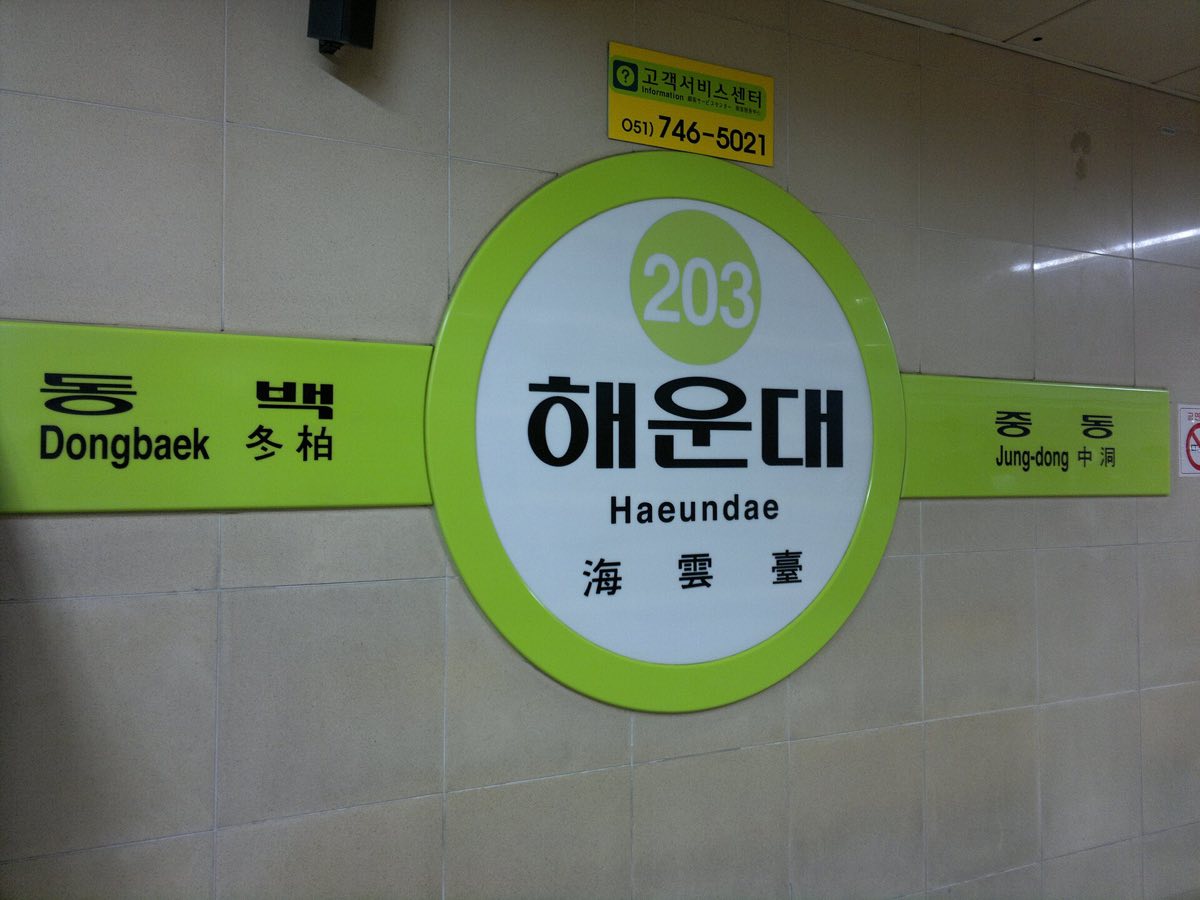
Every location on this site carries its metro line, station and exit — Busan's metro is cheap, frequent and bilingual, and the city is too spread out for 'just take a taxi' to survive contact with Friday traffic on the Gwangan Bridge. Hangul names are included so you can show them to a taxi driver when you do cave. Rides run about ₩1,600–1,800 (~$1.10–1.25) on a T-money or Cashbee card, and the network — four numbered lines, the Donghae Line and the airport light rail — reaches almost everything on this site.
Getting anywhere from anywhere
Commute timesBusan is not a city with a centre. It is a 40 km ribbon of separate towns wrapped around a coastline and cut apart by mountains — Haeundae to Gamcheon is about an hour each way, every time. The #1 planning mistake is booking the famous beach and then commuting daily to the postcard sights on the opposite side of the city. Tap the base you're sleeping in and read your real door-to-door minutes to everything worth doing — this one table is most of what this page has to teach.
| Stop | Getting there | From Haeundae | From Gwangalli | From Seomyeon | From Nampo |
|---|---|---|---|---|---|
| Gamcheon Culture Village감천문화마을West · old Busan | Line 1 · Toseong · Exit 6, then Saha 1 or 1-1 village bus | 80 min | 65 min | 45 min | 25 min |
| Songdo cable car송도해상케이블카West · old Busan | Line 1 · Jagalchi · Exit 2, then bus 6, 26, 30, 71 or 96 | 85 min | 70 min | 50 min | 25 min |
| Jagalchi Market자갈치시장West · old Busan | Line 1 · Jagalchi · Exit 10 | 60 min | 45 min | 20 min | 5 min |
| Nampo & BIFF Square남포동West · old Busan | Line 1 · Nampo · Exit 7 | 60 min | 45 min | 20 min | you are here |
| Taejongdae (Yeongdo)태종대West · old Busan | Bus 8, 30, 66 or 88 from Nampo · Exit 6 | 75 min | 60 min | 45 min | 25 min |
| Busan Station부산역West · old Busan | Line 1 · Busan Station · Exit 8 (cruise terminal 10 min by taxi) | 45 min | 35 min | 15 min | 10 min |
| Seomyeon서면Hinge | Lines 1 + 2 cross here · Seomyeon Station | 40 min | 25 min | you are here | 20 min |
| Hwangnyeongsan lookout황령산Hinge | No metro — taxi only, about 30 min / ₩16,000 from Nampo | taxi | taxi | taxi | taxi |
| Igidae Coastal Trail이기대East · beaches | Line 2 · Kyungsung Univ. · Exit 5, then bus 20, 39 or 131 | 35 min | 20 min | 30 min | 45 min |
| Gwangalli Beach광안리해수욕장East · beaches | Line 2 · Gwangan · Exit 3 or 5, 5-min walk | 20 min | you are here | 25 min | 45 min |
| Centum City & Spa Land센텀시티East · beaches | Line 2 · Centum City · Exit 12, straight into Shinsegae | 10 min | 15 min | 30 min | 50 min |
| Haeundae Beach해운대해수욕장East · beaches | Line 2 · Haeundae · Exit 3 or 5, 8-min walk | you are here | 20 min | 40 min | 60 min |
| Blueline Park (Mipo)해운대블루라인파크East · beaches | Line 2 · Haeundae · Exit 1, then 10-min walk to Mipo | 10 min | 30 min | 50 min | 70 min |
| Songjeong Beach송정해수욕장East · beaches | Donghae Line · Songjeong · 15-min walk | 25 min | 40 min | 55 min | 75 min |
| Haedong Yonggungsa해동용궁사East · beaches | Donghae Line · OSIRIA · Exit 1, then bus 1001 or 139 | 40 min | 55 min | 65 min | 85 min |
Minutes are rounded door-to-door estimates by metro, bus and foot, off-peak. Fares are our best estimate at about ₩1,600–1,800 a ride — verify current fares at humetro.busan.kr.
Six lines, and what each one does for you
The networkYou will realistically ride three of these. Here's the whole map in plain words.
| Line | What it does for a visitor |
|---|---|
| Line 1 | The old-Busan spine: Nampo, Jagalchi, Busan Station, Toseong (for Gamcheon), up through Seomyeon |
| Line 2 | The beach line: Haeundae, Gwangan, Centum City, Kyungsung — and it crosses Line 1 at Seomyeon |
| Lines 3 & 4 | Transfer connectors across the inland districts — useful, rarely memorable |
| Donghae Line | The commuter rail everyone misses: Songjeong Beach and OSIRIA (Yonggungsa, Lotte World) without traffic |
| Busan–Gimhae LRT | The airport link — meets Line 2 at Sasang |
The Donghae Line is the sleeper hit: it turns Yonggungsa and the Osiria resort strip from a traffic gamble into a train ride.
Fares, cards, and the gate that refuses your bank card
Fares & cardsRides cost about ₩1,600–1,800 depending on distance — our best estimate; verify at humetro.busan.kr — paid with a T-money (works nationwide, including all of Busan), Cashbee (the Busan-family card) or WOWPASS (airport-kiosk card with transit built in). All reload with cash only, at station machines and convenience stores. Tapping a foreign contactless bank card at the gate: assume it fails — this city is not on open-loop payments, and neither are the ticket kiosks. The full card decision lives at money in Busan.
Curiosity for the spreadsheet crowd: Busan's monthly pass is ₩80,000 — 26% more than Seoul's ₩63,500, in the city with cheaper restaurants. Tourists on single fares won't care; month-plus stayers should do the sums before assuming the pass wins.
The taxi reality, including the Kakao T catch
TaxisTaxis are cheap by global standards — ₩4,800 (~$3.40) flagfall, then roughly ₩1,000 per kilometre — and meters take foreign cards. The catch is hailing by app: Kakao T wants Korean-phone verification at signup, and its foreign-card support is unverified — treat the app as unavailable and you'll never be disappointed. The street hail, the taxi rank and the hotel-desk call all work exactly as they did before apps. Show the driver the Hangul name printed on every page of this site.
When taxis earn their fare: the Hwangnyeongsan lookout (no metro, about ₩16,000 from Nampo), late nights after the metro winds down, and any hop where four of you split the meter. When they don't: Friday evening across the Gwangan Bridge — the weekday rush-hour tolls were eliminated on 8 July 2026, but the traffic wasn't. Buses fill the gaps the metro misses: the Saha 1 village bus up to Gamcheon, the 1001 along the coast — same transit card, tap on and off.
Transfers, pre-booked
When you'd rather be drivenFor airport runs and luggage days, a fixed price booked ahead beats negotiating a rank.
Busan transit questions, answered
FAQPage schema pairedHow much is the Busan Metro?
About ₩1,600–1,800 (~$1.10–1.25) a ride on a transit card, by distance — our best estimate, worth verifying at humetro.busan.kr. Cash single tickets cost slightly more and the kiosks reject foreign cards, so the transit card isn't optional in practice.
Does my Seoul T-money card work in Busan?
Yes — T-money works nationwide, Busan Metro and buses included, so don't buy a second card. Just top it up with cash: convenience stores and station machines do it in 30 seconds.
Do Busan taxis take foreign credit cards?
Generally yes — taxis are on the reliable side of Korea's card divide, along with chains and convenience stores. Flagfall is ₩4,800 with roughly ₩1,000/km after, so cross-town hops in a shared cab often beat four metro fares.
Can foreigners use Kakao T?
Signup wants Korean-phone verification, and foreign-card support in the app is unverified — so plan around it rather than on it. Street hails and hotel calls work fine, and the ₩4,800 flagfall means being appless costs you nothing but a raised arm.
Is Busan walkable?
Within a neighbourhood, thoroughly. Between neighbourhoods, no — this is a 40 km ribbon, and Haeundae to Gamcheon runs about an hour each way, every time. Pick the right base with where to stay and let the metro do the distance.
How do I get from Gimhae Airport into the city?
The Busan–Gimhae LRT to Sasang, then Line 2 — about 70 minutes to Haeundae, less to Seomyeon — or a taxi at 40–55 minutes to the beaches. Every route and fare band: Gimhae Airport to the city.
What time does the Busan Metro stop running?
Plan on last trains around 23:00 — and verify current times at humetro.busan.kr rather than trusting a blog, ours included. Miss it and the taxi meter starts at ₩4,800 (~$3.40) plus night surcharges — survivable for a cross-neighbourhood hop, expensive across a 40 km ribbon. A late airport landing is its own case, handled at Gimhae Airport to the city.
Can I tap a foreign contactless card on the Busan Metro?
Assume no — foreign contactless cards on Korean transit are the wrong bet, whatever your bank promises. The working answer is a transit card (T-money, Cashbee or WOWPASS) topped up with cash, which takes about 30 seconds at any convenience store and unlocks the ₩1,600–1,800 (~$1.10–1.25) card fare. The three cards are compared properly at money in Busan.